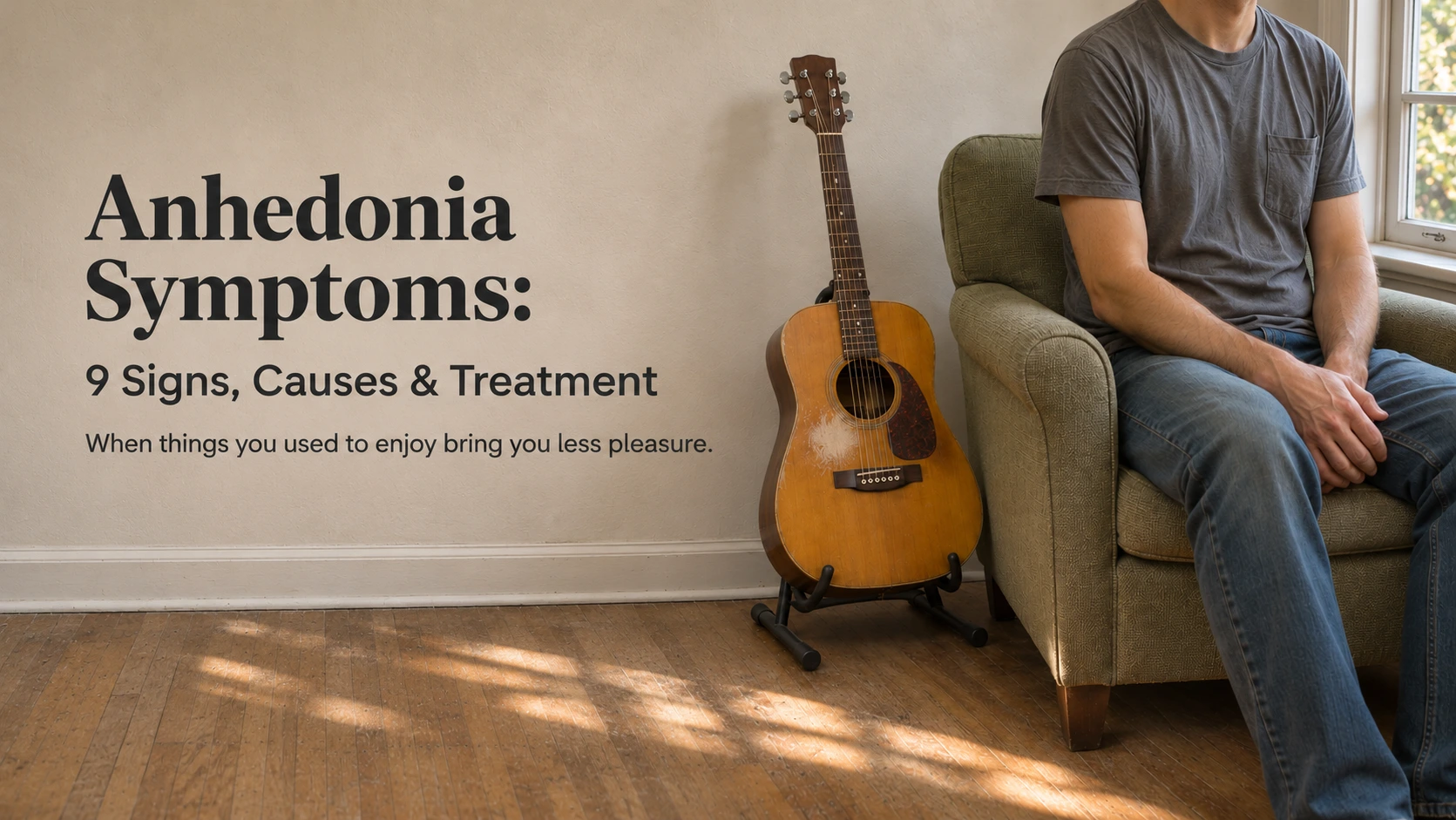
Anhedonia Symptoms: 9 Signs You May Feel Numb Instead of Sad
Have you ever felt like you're doing everything you're supposed to do, but you're no longer enjoying the life you're working so hard to maintain?
You go to work. You take care of your family. You make plans, celebrate milestones, and keep up with your responsibilities.
But something feels different.
The things that once made you happy don't bring the same satisfaction anymore. You might not feel particularly sad, either. You simply don't feel the enjoyment you remember.
This loss of interest or pleasure may be a symptom called anhedonia.
Anhedonia symptoms include reduced enjoyment of previously rewarding activities, difficulty looking forward to positive experiences, and feeling less satisfaction from relationships, hobbies, or accomplishments.
Anhedonia can occur with depression, but it isn't always caused by depression. Understanding the difference is important because the most appropriate treatment depends on what is contributing to the change.
What Is Anhedonia?
Anhedonia is a reduced ability to experience pleasure or a marked loss of interest in activities that would normally feel enjoyable or rewarding.
Think about something you genuinely love doing.
Maybe it's listening to music on your way home, cooking with your family, playing a sport, or spending time with close friends.
Now imagine that you can still participate in those activities, but the enjoyment you once experienced is missing.
You recognize that the activity should be pleasant. You may even remember exactly how it used to make you feel.
But the emotional reward isn't there.
That's one way anhedonia can present.
Anhedonia isn't the same as occasionally feeling bored, needing a break, or losing interest in a particular hobby. The concern becomes more significant when the change is persistent, noticeably different from your usual experience, or affects your quality of life.
Researchers also recognize that pleasure involves several processes, including anticipation, motivation, and enjoyment during an activity. These processes don't always change together.
Clinical reference: Treadway and Zald, 2011; Rizvi and colleagues, 2016.
9 Anhedonia Symptoms That Are Easy to Overlook
Anhedonia doesn't look the same in everyone.
Some people experience a broad loss of enjoyment. Others notice the change mainly in their relationships, hobbies, or sense of accomplishment.
These nine signs can help you recognize what reduced interest or pleasure may look like in everyday life.
1. Things You Used to Love Feel Like Responsibilities
You used to look forward to going to the gym, cooking dinner, gardening, or spending time on a hobby.
Now those activities feel like tasks you have to complete.
You may still do them, but the enjoyment that once motivated you seems to have disappeared.
The important distinction is whether this represents a meaningful change from your usual interests.
2. You Don't Feel Excited About Upcoming Events
Maybe you have a vacation planned, a birthday approaching, or tickets to something you've wanted to attend.
You know it's supposed to be exciting.
But you don't feel much anticipation.
This can involve a reduction in anticipatory pleasure, the enjoyment associated with looking forward to something rewarding.
3. Good Experiences Don't Feel as Good Anymore
Sometimes you look forward to an activity but feel surprisingly little enjoyment once you're actually participating.
You might go to your favorite restaurant, attend a celebration, or spend a weekend doing something you normally love.
Everything goes according to plan, yet the experience feels emotionally flat.
This is different from simply having an occasional disappointing day.
4. Spending Time With People Feels Less Rewarding
You may still love your partner, children, family, or friends.
But conversations, outings, and shared activities no longer feel as enjoyable as they once did.
It's important to understand that reduced enjoyment in a relationship doesn't automatically mean reduced love or affection.
Changes in social pleasure can have several explanations, including anhedonia.
5. Your Accomplishments Don't Bring Satisfaction
You work hard toward a goal, finally achieve it, and expect to feel proud.
Instead, you feel surprisingly little.
This can be confusing, particularly when you've spent weeks or months working toward something important.
The achievement still matters, but your emotional response feels different.
6. Music, Food, or Other Pleasurable Experiences Feel Less Enjoyable
You may notice that favorite songs don't affect you the same way, familiar meals are less enjoyable, or physical affection feels less rewarding.
This is sometimes described as reduced physical or sensory pleasure.
It doesn't necessarily mean your physical senses have changed. A loss of taste, smell, or physical sensation can have separate medical causes.
7. You Start Avoiding Activities Because They No Longer Feel Worthwhile
When something repeatedly stops feeling rewarding, it can become harder to find a reason to participate.
You might decline invitations, stop pursuing hobbies, or gradually spend more time alone.
Over time, this can reduce opportunities for connection and positive experiences.
However, avoidance and reduced motivation can also occur with anxiety, exhaustion, attention difficulties, and other conditions.
8. You Feel Emotionally Flat Rather Than Sad
You might describe yourself as numb, disconnected, or emotionally distant.
Positive experiences don't bring the feelings you expect, even though you understand their importance.
This can overlap with anhedonia, but emotional numbness is a broader experience that may affect positive and negative emotions.
9. You're Functioning Normally, but Life Feels Less Enjoyable
You may still be meeting deadlines, caring for your family, paying bills, and maintaining your responsibilities.
Other people might not notice anything different.
But internally, you feel less engaged or fulfilled.
Being able to function doesn't necessarily mean your emotional well-being is unaffected.
At the same time, these experiences are not enough on their own to establish a psychiatric diagnosis.
Can You Have Depression Without Feeling Sad?
Yes. You can experience major depression without persistent sadness.
This is one of the most important things to understand about anhedonia.
Many people associate depression primarily with sadness, crying, or feeling hopeless.
But depression doesn't always present that way.
According to the National Institute of Mental Health, a major depressive episode can involve depressed mood or a marked loss of interest or pleasure as a central symptom.
The diagnostic criteria also require additional symptoms, generally lasting at least two weeks, along with appropriate assessment of distress, functioning, and other possible causes.
Someone experiencing depression may notice changes in:
· Sleep or appetite.
· Energy and motivation.
· Concentration and decision-making.
· Feelings of worthlessness or excessive guilt.
· Movement or activity levels.
· Interest in relationships and previously enjoyable activities.
Thoughts of death or suicide can also occur and require prompt attention.
Anhedonia alone does not establish major depressive disorder. However, the absence of sadness does not rule it out.
That distinction is why a comprehensive evaluation matters.
Clinical reference: National Institute of Mental Health, Depression.
For additional information, read How to Find the Right Depression Treatment.
Anhedonia vs. Depression, Emotional Numbness, and Burnout
When someone says, "I don't feel like myself anymore," the experience may involve several different symptoms.
Understanding those differences can help prevent assumptions about what is happening.
|
Experience |
What it means |
|
Anhedonia |
Reduced interest in or pleasure from previously rewarding experiences |
|
Depression |
A clinical disorder involving a broader pattern of qualifying symptoms |
|
Emotional numbness |
A general reduction in emotional responsiveness or connection |
|
Burnout |
A work-related phenomenon associated with chronic occupational stress |
These experiences can overlap.
Someone experiencing burnout may also have depression. A person taking antidepressant medication may report emotional blunting while still experiencing symptoms of depression.
And someone with anhedonia may continue experiencing sadness, anxiety, frustration, or other emotions.
The most useful approach is to understand what the person is experiencing rather than assuming that similar descriptions always mean the same thing.
Related reading: Understanding the Differences Between Depression and Burnout.
Are There Different Types of Anhedonia?
Researchers commonly discuss several dimensions of anhedonia.
Social Anhedonia
Social anhedonia involves reduced enjoyment from relationships and social experiences.
A person may still value their relationships but experience less pleasure during interactions.
This is not the same as introversion or simply preferring to spend time alone.
Physical Anhedonia
Physical anhedonia involves reduced pleasure from sensory or physical experiences, such as food, music, touch, or physical intimacy.
It should not be confused with physical numbness or loss of sensation.
Anticipatory and Consummatory Pleasure
These terms describe two aspects of reward processing.
Anticipatory pleasure is the enjoyment associated with looking forward to an experience.
Consummatory pleasure is the enjoyment experienced while participating in it.
For example, someone might have difficulty feeling excited about a family trip but enjoy it once they arrive.
Another person might look forward to the trip but find the experience itself less rewarding than expected.
Understanding these differences can help explain why anhedonia is more complex than simply not feeling happy.
Clinical reference: Rizvi and colleagues, 2016.
What Causes Anhedonia?
There isn't one explanation that fits everyone.
Anhedonia may occur in association with several conditions or contributing factors.
Depression and Other Psychiatric Conditions
Loss of interest or pleasure is a core symptom of major depression.
Anhedonia can also occur with certain other psychiatric conditions, including schizophrenia-spectrum disorders.
The significance of the symptom depends on the broader clinical picture.
Chronic Stress and Exhaustion
Prolonged stress can affect motivation, engagement, and enjoyment.
However, it is important not to assume that persistent loss of pleasure is simply burnout or that taking time off will necessarily resolve it.
Medication-Related Emotional Changes
Some people report emotional blunting while taking antidepressants.
It can be difficult to distinguish medication-related effects from residual depressive symptoms or other contributing factors.
If you notice changes after starting or adjusting a medication, discuss them with your prescribing clinician.
Never stop or change prescribed psychiatric medication without professional guidance.
Sleep, Substance Use, and Medical Factors
Significant sleep disturbances, substance use or withdrawal, and certain medical conditions may contribute to changes in mood, motivation, or pleasure.
These factors may need to be considered during an evaluation.
Is Anhedonia Caused by Low Dopamine?
You may have heard that anhedonia means your brain isn't producing enough dopamine.
The science is more complicated.
Dopamine plays an important role in motivation and reward-related processes, but pleasure involves multiple interacting systems.
There is no routine dopamine blood test that can diagnose anhedonia or identify its underlying cause.
Clinical reference: Treadway and Zald, 2011.
How Does a Psychiatric Provider Evaluate Anhedonia?
When someone reports that nothing feels enjoyable anymore, the goal of a psychiatric evaluation is not simply to decide whether they are depressed.
It is to understand the change in the context of their overall mental and physical health.
A thoughtful evaluation explores several important questions.
What Has Actually Changed?
A provider may ask which activities previously brought enjoyment and how those experiences feel now.
This helps distinguish a persistent change in pleasure from a normal shift in interests or preferences.
When Did the Symptoms Begin?
Timing can provide important clues.
For example, symptoms that developed gradually over several months may have a different context from changes noticed after a medication adjustment or significant life event.
Is the Difficulty With Motivation, Pleasure, or Both?
Someone may want to participate in activities but struggle to initiate them.
Another person may participate regularly but experience little enjoyment.
These experiences can overlap, but they may require different clinical considerations.
Are Other Symptoms Present?
A provider may ask about mood, sleep, appetite, concentration, energy, anxiety, and daily functioning.
They may also screen for safety concerns and a history of manic or hypomanic symptoms when evaluating possible mood disorders.
Could Medications or Medical Conditions Be Contributing?
Medication history, substance use, sleep problems, and relevant medical concerns may help explain changes in enjoyment or emotional responsiveness.
Depending on the findings, further medical assessment or coordination with another healthcare professional may be appropriate.
What Does This Mean for Treatment?
The purpose of these questions is to develop an accurate understanding of the symptoms before recommending treatment.
An effective psychiatric evaluation considers the whole person—not just one symptom or questionnaire score.
How Is Anhedonia Treated?
Anhedonia can improve, but treatment depends on its underlying cause.
There is no single intervention that works for every person experiencing reduced pleasure.
Psychotherapy and Behavioral Activation
When anhedonia occurs alongside depression, psychotherapy may be an important part of treatment.
Behavioral activation is an evidence-based approach for depression that helps people gradually reengage in meaningful activities.
It recognizes that motivation and enjoyment may not return immediately.
Rather than waiting until someone feels excited about an activity, treatment may focus on manageable steps toward activities aligned with their values and goals.
Psychiatric Medication Management
Medication may be appropriate when anhedonia occurs as part of a condition for which psychiatric medication is indicated.
Treatment decisions should consider the diagnosis, symptom severity, medical history, previous response to medication, and potential side effects.
A medication that helps one person may not be appropriate for another.
Reviewing Possible Medication Effects
If emotional blunting or reduced pleasure developed after starting or changing medication, a clinician may review the timing and discuss potential treatment adjustments.
These decisions should always be individualized and medically supervised.
Addressing Other Contributing Factors
Sleep disturbances, medical concerns, substance-related factors, and chronic stress may also need attention.
In some situations, coordinated care involving a psychiatric provider, primary care clinician, or psychotherapist may be appropriate.
How Do You Know if Treatment Is Helping?
Progress isn't always measured by whether someone feels less sad.
For a person whose primary concern is anhedonia, meaningful changes may include:
· Looking forward to activities again.
· Feeling more engaged during social interactions.
· Experiencing satisfaction after accomplishments.
· Reconnecting with previously enjoyable interests.
· Noticing improvements in daily functioning.
Progress may be gradual and can vary from person to person.
Monitoring the symptoms that matter most to the individual is an important part of evaluating treatment response.
What Can You Do if Nothing Feels Enjoyable Anymore?
If you've noticed a persistent change, start by paying attention to what feels different.
You don't need to diagnose yourself.
It may help to write down which activities you previously enjoyed, when the change began, whether you still participate in them, and what happens when you do.
Also consider whether you've noticed changes in sleep, energy, appetite, concentration, medication use, or stress.
This information can make a conversation with a healthcare professional more productive.
You can also try maintaining manageable routines and staying connected with supportive people.
However, persistent loss of pleasure shouldn't be dismissed as something you simply need to push through.
You don't need to force yourself to feel happy before asking for help.
When Should You Seek Professional Help for Anhedonia?
Consider a mental health evaluation if you've experienced a noticeable loss of interest or pleasure that:
· Persists for approximately two weeks or longer.
· Affects your relationships or daily responsibilities.
· Occurs alongside changes in sleep, appetite, energy, or concentration.
· Began after a medication adjustment.
· Causes distress even though you're still managing everyday life.
You can seek help sooner if symptoms are concerning or worsening.
If you're experiencing suicidal thoughts or feel unable to stay safe, call or text 988 in the United States for crisis support. For immediate danger, call 911 or seek emergency care.
Understanding Your Symptoms With Luna Bloom Psychiatry
Personalized Psychiatric Care Starts With Understanding What You're Experiencing
When you stop enjoying things that once mattered to you, it's natural to wonder whether you're experiencing depression, burnout, emotional numbness, or something else.
You don't have to determine the answer on your own before seeking an evaluation.
At Luna Bloom Psychiatry, our psychiatric mental health nurse practitioners provide individualized telehealth psychiatric evaluations and medication management when clinically appropriate.
During an initial evaluation, your provider may discuss your current concerns, symptom history, sleep, mood, medications, medical background, and how your experiences are affecting everyday life.
The purpose is to better understand what may be contributing to your symptoms and discuss appropriate next steps.
Depending on your needs, recommendations may include medication management, psychotherapy referrals, additional medical evaluation, or coordinated care.
Our approach emphasizes thoughtful assessment and individualized treatment decisions rather than assuming that every patient needs the same solution.
Virtual appointments are available for eligible patients in states where our providers are authorized to practice. Provider availability and insurance participation may vary.
Explore Psychiatric Care at Luna Bloom Psychiatry
You can also learn more about our provider, Ashley Nerusu, PMHNP-BC.
Frequently Asked Questions About Anhedonia
1. What are the most common anhedonia symptoms?
Common anhedonia symptoms include reduced enjoyment from hobbies, diminished pleasure during social interactions, difficulty looking forward to positive experiences, and feeling less satisfaction from activities or achievements that previously felt rewarding.
2. What does anhedonia feel like?
Anhedonia may feel like participating in familiar activities without experiencing the enjoyment you once did. Some people describe feeling emotionally flat, while others primarily notice a loss of excitement, interest, or satisfaction.
3. Can you have anhedonia without depression?
Yes. Anhedonia can occur without meeting the criteria for major depressive disorder. Other psychiatric conditions, medication effects, substance-related factors, and medical concerns may contribute.
4. Can you have depression without feeling sad?
Yes. Major depression can occur without persistent sadness when a marked loss of interest or pleasure is present alongside the other required diagnostic criteria.
5. Is anhedonia the same as emotional numbness?
No. Anhedonia specifically involves reduced interest or pleasure. Emotional numbness may involve a broader reduction in emotional experiences. The two can overlap but aren't interchangeable.
6. Is anhedonia the same as burnout?
No. Burnout is a work-related phenomenon associated with chronic occupational stress. Anhedonia involves reduced interest or pleasure and can occur in several clinical contexts. Symptoms may overlap.
7. Can anxiety and anhedonia happen together?
Yes. Anxiety and anhedonia can occur together, particularly when depression, prolonged stress, or other contributing conditions are also present. A clinical evaluation can help clarify the relationship.
8. Does anhedonia mean your dopamine is low?
Not necessarily. Dopamine contributes to motivation and reward processing, but anhedonia cannot be explained or diagnosed as a simple dopamine deficiency.
9. Can antidepressants cause emotional blunting?
Some people report emotional blunting while taking antidepressants. Residual depression and other factors can produce similar symptoms. Discuss concerns with your prescriber before changing medication.
10. Can anhedonia go away?
Anhedonia may improve, especially when contributing conditions are appropriately identified and addressed. The course of recovery depends on the underlying cause and individual circumstances.
11. How do psychiatric providers assess anhedonia?
Providers evaluate changes in interest, pleasure, motivation, mood, functioning, and related symptoms. They may also review medications, psychiatric history, sleep, substance use, and medical factors. Questionnaires can support but do not replace clinical assessment.
12. When should I seek help if nothing feels enjoyable?
Consider an evaluation when reduced pleasure persists, causes distress, or interferes with daily life. You don't need to wait until symptoms become severe to speak with a healthcare professional.
Final Thoughts: You Don't Have to Feel Sad for Your Symptoms to Matter
One of the most confusing aspects of anhedonia is that you may struggle to explain what feels wrong.
You're not necessarily sad. You may not be crying or withdrawing completely from everyday life.
You simply recognize that experiences that once brought enjoyment no longer feel the same.
That change deserves attention.
Anhedonia can occur for several reasons, and understanding the cause is more important than assigning yourself a diagnosis.
You don't have to know exactly what's happening before reaching out for help.
A thoughtful psychiatric evaluation can help you understand the symptoms you've been experiencing and explore appropriate treatment options.
Medical References
1. National Institute of Mental Health. Depression.
https://www.nimh.nih.gov/health/publications/depression
2. American Psychiatric Association. Diagnostic and Statistical Manual of Mental Disorders, Fifth Edition, Text Revision (DSM-5-TR). 2022.
3. Treadway MT, Zald DH. Reconsidering anhedonia in depression: Lessons from translational neuroscience. Neuroscience & Biobehavioral Reviews. 2011;35(3):537–555.
https://doi.org/10.1016/j.neubiorev.2010.06.006
4. Rizvi SJ, Pizzagalli DA, Sproule BA, Kennedy SH. Assessing anhedonia in depression: Potentials and pitfalls. Neuroscience & Biobehavioral Reviews. 2016;65:21–35.
https://doi.org/10.1016/j.neubiorev.2016.03.004
Medical Disclaimer: This article is intended for general educational purposes and does not replace individualized medical advice, diagnosis, or treatment. Persistent changes in interest, pleasure, or emotional experience may have multiple causes. Consult a qualified healthcare professional for evaluation and personalized care.


